
Spot Trading Strategy
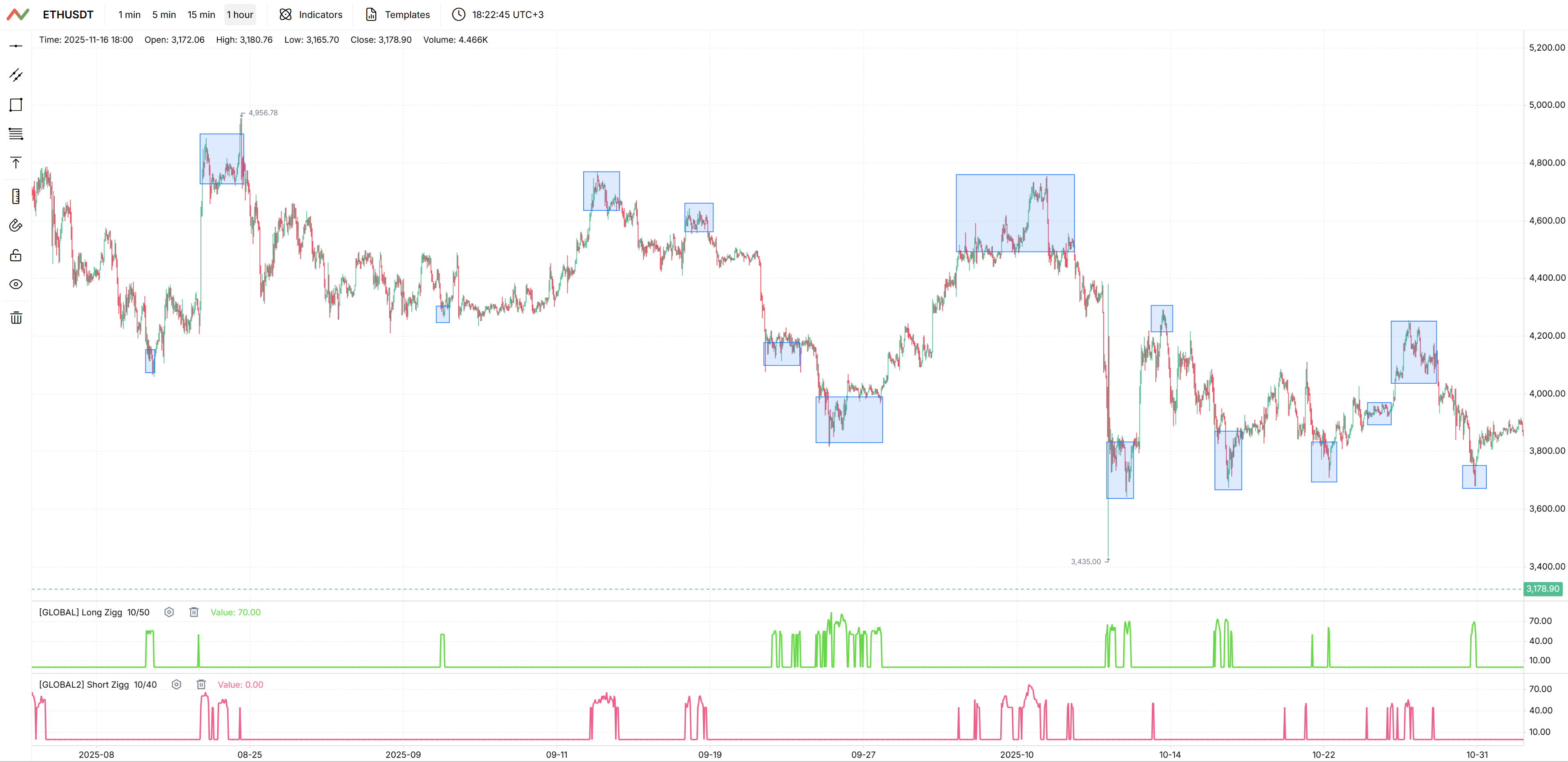
This is a simple, non-leveraged spot strategy that relies only on the global Long Zigg and Short Zigg indicators. The idea is to accumulate positions during phases where the market appears oversold and to take profit when short-side pressure increases.
Ziggs global indicators are not tied to any single asset — they reflect the state of the market as a whole. Historically, high Long/Short Zigg values correlate well with the total market cap excluding the top 10 coins, which means the strategy is suitable not only for ETH but for a wide range of liquid altcoins.
Indicators Used
-
[Global] Long Zigg
Depth: 10%, threshold: 50.
High values indicate increased long demand after a decline — conditions where gradual accumulation becomes reasonable. -
[Global 2] Short Zigg
Depth: 10%, threshold: 40.
Rising values reflect growing short activity and a higher probability of correction or a downward reversal.
The recommended timeframe for this strategy is 1 hour.
Approach to Risk and Position Size
This is an investment-style strategy: it focuses on phased accumulation and structured profit-taking rather than frequent trading. The key choice is not the risk percentage per trade, but the portion of your capital allocated to this approach.
- decide what percentage of your portfolio you want to allocate (for example, 10–30%);
- split this allocation into several parts (in this example — three equal portions);
- keep the remaining portfolio in stablecoins, other strategies, or outside the market.
For additional guidance on active-style risk management, see the “Risk Management” section.
1. Building a Spot Position
Entry decisions are based on the global Long Zigg indicator. We look for phases where its value is above the threshold.
Basic accumulation scheme:
- Monitor [Global] Long Zigg 10/50 on the 1H chart. Once the value rises above 50, the market enters a phase where accumulation becomes reasonable.
- On the first sustained signal above the threshold, buy approximately ⅓ of the planned total amount in ETH or another liquid altcoin. During potential long phases, it may be reasonable to spread entries across several altcoins — but avoid excessive diversification.
-
If, within the same long signal phase, Long Zigg remains elevated
while the asset price declines, add the remaining two parts:
- the second ⅓ — after a clear price decline relative to the first entry,
- the final ⅓ — after a further decline toward your predefined level.
This staggered approach reduces dependence on any single entry point. During strong global pressure, the position is built gradually as the market continues to load the long side.
2. Taking Profit
Exits are guided by [Global 2] Short Zigg 10/40. We focus on phases where its value rises above 40.
Basic exit logic:
- on the first sustained move above 40, lock in a substantial part of the position (e.g., 50–70%);
- for the remainder you may:
- hold it for potential trend continuation,
- or close it on the next strong Short Zigg spike or when price returns to a chosen level.
This ensures that the main profit is captured during rising short pressure, while preserving flexibility for possible further growth.
3. Suitable Assets
- large-cap and mid-cap altcoins with stable liquidity are natural candidates;
- global Zigg indicators correlate particularly well with the “market minus top-10” segment, so many altcoins often react even more clearly than ETH;
- low-liquidity assets may behave unpredictably and require additional validation.
4. Alerts Instead of Manual Monitoring
You can automate the entire process using Ziggs alerts:
- Global Long Zigg 10/50 — to signal accumulation conditions;
- Global 2 Short Zigg 10/40 — to highlight zones where profit-taking is reasonable.
Alerts are delivered via the Ziggs Telegram bot. The setup guide is available here: “Alerts: Guide”.
We also share live market examples in our Telegram channel: https://t.me/ziggsapp.
5. Limitations and What to Keep in Mind
- a high Long Zigg value does not guarantee immediate reversal — pressure may persist;
- Short Zigg above the threshold marks increased short interest, but may not align exactly with tops;
- the strategy provides structure, but allocation, horizon, and acceptable drawdowns are personal decisions.
In summary, this is a structured spot accumulation framework: positions are built during phases of global long-side pressure and reduced during phases of elevated short-side activity. Thresholds, allocations and holding periods can be adjusted to your personal style and portfolio plan.